

Program 01 is the first BrainGain.Expert program: a pilot in Ukraine for 2026 to 2028 that places experienced Fellows inside Ukrainian companies until the capability stays. The need is deepest here, our network is strongest here, and businesses keep rebuilding here under pressure. Before the method travels to other countries, Program 01 has one job: to prove that expertise inside a company changes its results.
Why we start with Ukraine

In the space of a single year, a dairy plant in central Ukraine loses its export manager and two engineers. On paper, little else has changed: it employs 140 people, has reliable suppliers and holds contracts abroad. The equipment is in place, the raw milk is there, the demand is there. But export certification stalls, production planning falls apart, and one contract after another goes to competitors.
This is the main problem of Ukrainian business today: people. Many talented specialists are serving in the army or have been forced to leave the country. Equipment can be bought and loans can be raised, but a strong local team cannot be assembled overnight.
Now picture the other side. A former export director who left Ukraine now lives elsewhere in Europe. She wants to do something that matters for her country, but she is no longer there. In a few months she could restore the plant's certification and rebuild planning together with its team, then hand the process to an internal owner and step back, leaving the capability inside the company.
Or take a quality specialist from Germany who has spent years bringing food products to the EU market. He knows the requirements of European retail chains and certification standards from the inside. With a Fellow like him, the plant could not only win back its old contracts but also reach markets it never reached before.
Program 01 exists to make that meeting happen by method, not by chance.
An economy that is short of people
Ukraine's real GDP fell by 28.8% in 2022, according to the State Statistics Service. It recovered by 5.5% in 2023 and 2.9% in 2024, and growth slowed to around 2% in 2025. The economy is still roughly a fifth smaller than it was in 2021.

The binding constraint is people. In June 2026, a record 71% of Ukrainian industrial firms named staff shortages, caused by mobilization or emigration, as their main obstacle, according to a monthly survey by the Institute for Economic Research and Policy Consulting. Some 5.76 million Ukrainian refugees live abroad, according to UNHCR, and the government's draft budget provides for about 3.7 million registered internally displaced people.
The paradox is that the shortage sits next to unemployment of about 15.5%, according to Info Sapiens (March 2026). The expertise exists, inside the country and beyond its borders.

Equipment can be bought and loans can be raised. A strong team cannot be assembled overnight.
Money for business support exists too, even if it is not enough. Since 2022, EBRD risk-sharing facilities have enabled more than 2.4 billion euros of new lending through Ukrainian banks, across more than 30,000 sub-loans, mostly to small and medium businesses, according to the EBRD. In the first year of the government's eRobota program, the state channeled 4 billion hryvnias in grants to more than 5,600 entrepreneurs. Almost all of these instruments finance loans, guarantees and equipment. Expertise inside the company remains the line item that almost no one pays for. We described this gap in People need people: why we built BrainGain.Expert. Program 01 is how we start closing it.
How Program 01 works
Back to the dairy plant. This is how its path through Program 01 would look:
- 1. Application and diagnosis (first 2 to 3 weeks). The owner describes the problem: "we are losing export contracts." A diagnosis across four areas shows the real gap: no one owns certification and planning. The business makes a 12-month commitment.
- 2. Matching. The platform, using AI under the supervision of our team, proposes a shortlist of Fellows who have solved similar problems before. The owner interviews them and makes the choice.
- 3. Advise and Solve (4 to 12 weeks). The Fellow studies the situation, proposes a solution and builds a first working version: a plan to restore certification and a new production planning system.
- 4. Implement and Operate (12 to 24 weeks). The Fellow works inside the company, part-time or full-time, puts the changes into practice and trains the team. The company shares the cost of the role from day one and gradually takes it over in full.
- 5. Graduation and grant (6 to 12 months). The process has an internal owner and runs without the expert. A business that completes the program and puts the change into practice can receive a growth grant.
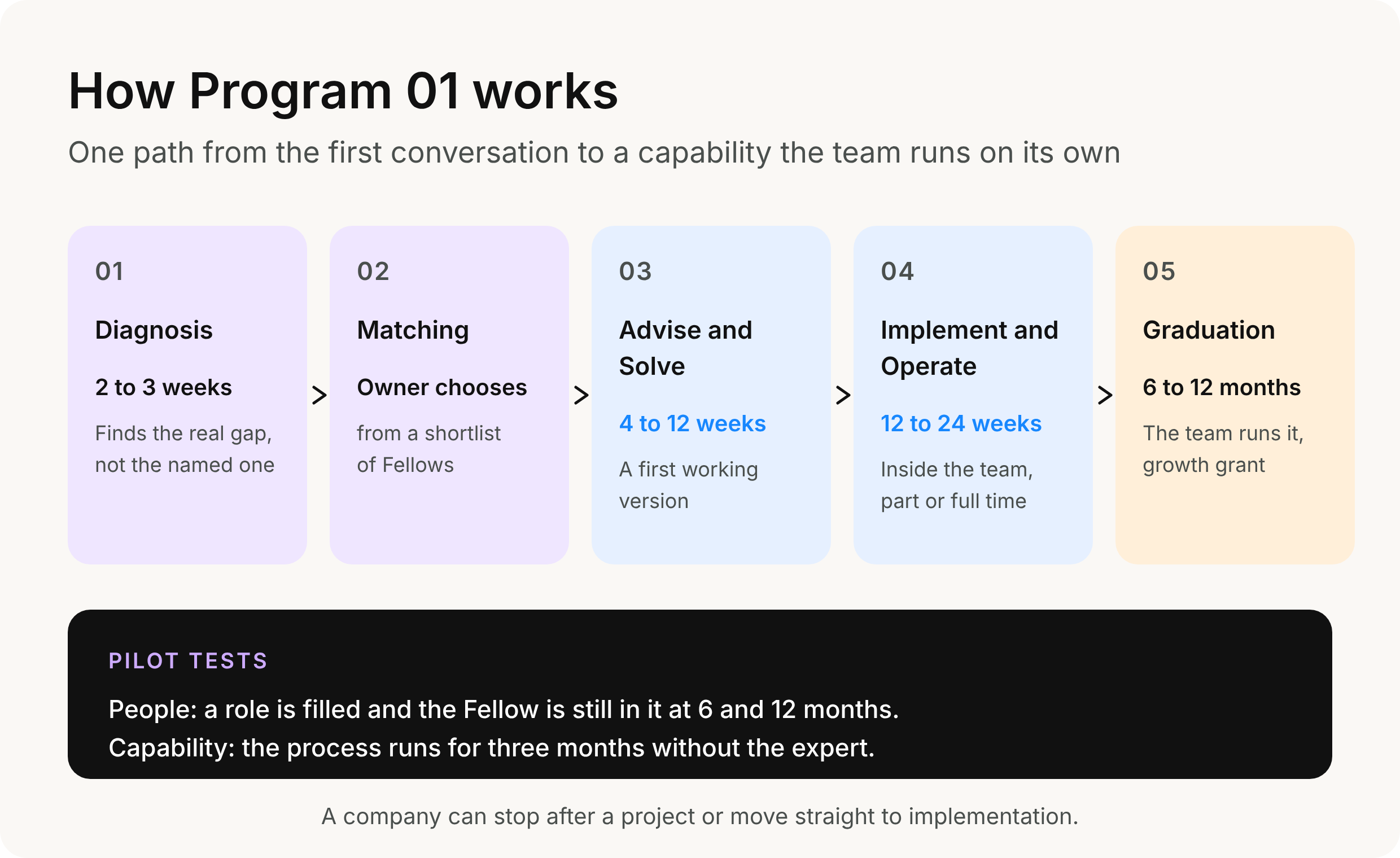
The path is not fixed. A company can stop after a project, or move straight to implementation when the need is clear. Every step ends with a decision made by people, not by an algorithm.
We ask three things of a business: the owner's time, access to data, and a readiness to hire once the need is confirmed. Donors fund the diagnosis, the project and the transition period. Why this is a strong use of European donor money, we explain in One grant, two results: why donors no longer have to choose.
Who takes part
- Businesses: small, medium and strategically important large Ukrainian companies that need people, tools or expertise to start, recover or grow. We do not limit the program to social enterprises: in a fragile economy, every company that keeps operating keeps jobs, pays its suppliers and pays taxes. Typical needs are strategy, operations, people, digitalization and AI, new markets and access to grants.
- Fellows: experienced operators, senior professionals, academics, people with rare expertise, veterans, professionals reinventing their careers in the age of AI, and graduates ready for a real case. Many are Ukrainians abroad who can help the economy at home without moving back. Fellows work remotely in whatever format the task requires: a consultation, a fixed-scope project, or a part-time or full-time role, for example as a fractional finance, operations or technology lead.
- Partners: private donors, foundations, companies, public institutions and technology partners. Technology partners contribute software, licenses and AI credits to the Resource Pool for businesses and Fellows, but never buy access to the companies we work with.
The pilot plan and how we measure results
- 2026, launch: the first companies and Fellows join. Every business goes through a diagnosis at entry, and the baseline is published in aggregate form.
- 2027, scale and evidence: more companies and Fellows, the first grants for those who complete the program, and the first independent evaluation.
Before launch, we are testing the model: interviews with business owners and experts, surveys of companies in Ukraine and of potential Fellows, and the first community events in Berlin and online.
We measure success with two tests. The people test: a role is filled, and the Fellow is still in it at 6 and 12 months. The capability test: a process is documented, has an internal owner and runs for three months without the expert. In the pilot, we are testing the hypothesis that 70% of placements will last at least 6 months, and that half of the capabilities will still be running 3 months after the Fellow leaves.
A role counts only if it would not have been filled without the program. Placements that end early are published with the reason. Results are assessed by an independent party, and we report once a year.
Why this matters beyond Ukraine
Ukraine is the first program, not the only one. The method is built for any fragile or recovering economy: start from a real business need, match people who have solved the same problem before, and leave the capability inside the company. If the pilot proves the result, Jordan, Albania and Kosovo come next, and 15 more economies have already been assessed for future programs.
For the dairy plant in our example, success looks simple. Export contracts are back, 140 jobs are kept, and suppliers are paid. And a process that once depended on one person now belongs to the team. Program 01 is in preparation: business owners can join the waitlist, experts can apply to the Fellowship, and donors can help fund the first cohort.